


Guide to the individual coverage HRA (ICHRA)
This is the ultimate guide for employers, benefits consultants, and HR professionals looking to offer a customizable and tax-free personalized health benefit. With an individual coverage health reimbursement arrangement (ICHRA), now known as the CHOICE Arrangement, you can take back control of your benefits budget.

- Intro Introduction
- Chapter 1: What is an ICHRA?
- Chapter 2: When was the ICHRA created?
- Chapter 3: What are the benefits of an ICHRA?
- Chapter 4: How does an ICHRA work?
- Chapter 5: Who can offer an ICHRA?
- Chapter 6: Who can participate in an ICHRA?
- Chapter 7: Can business owners participate in an ICHRA?
- Chapter 8: ICHRA affordability rule
- Chapter 9: How does an ICHRA compare to other types of HRAs?
- Chapter 10: What is the CHOICE Arrangement?
- Chapter 11: How PeopleKeep by Remodel Health can help
Want to break free from traditional group health insurance?
While health benefits have traditionally been one-size-fits-all and costly to offer, they don’t have to be. Today, personalization and flexibility are what employees expect and what will win them over in a tight labor market. So, how do you offer health benefits tailored to your employees’ unique needs without breaking the bank?
By offering an individual coverage HRA (ICHRA), you can reimburse your employees for their individual health insurance premiums and qualifying out-of-pocket medical expenses.
Are you already offering a traditional group health plan? You can also offer an ICHRA to employee classes that don’t qualify for your group plan, extending your benefits package to different groups.
This guide will cover everything you need to know about offering an ICHRA.
What is an ICHRA?
An individual coverage HRA is a type of health reimbursement arrangement (HRA). It’s a formal group health plan that allows organizations of any size to reimburse their employees, tax-free, for their qualified individual health insurance premiums and other qualifying medical expenses under IRS Code 213(d).1 The federal government lists eligible expenses in IRS Publication 5022 and the CARES Act3.
For organizations with 50 or more full-time equivalent employees (FTEs) — known as applicable large employers (ALEs) — an ICHRA is an excellent solution for satisfying the Affordable Care Act’s employer mandate.
Whether you choose to offer your ICHRA as a stand-alone benefit to all your employees or as a separate benefit for employee classes that don’t qualify for your group health insurance policy (such as remote staff members in states other than where your main office is or part-time employees), offering an affordable allowance can help you meet the requirements of the mandate.
When was the ICHRA created?
In 2013, IRS Notice 2013-54 limited organizations’ ability to offer HRAs4. The notice, which provided further guidance on the Affordable Care Act (ACA), essentially prevented HRAs from being integrated with nongroup health insurance, except in limited circumstances.
Congress provided some relief in December 2016 by creating the qualified small employer HRA (QSEHRA). With a QSEHRA, small employers with fewer than 50 FTEs could again offer an HRA for individual health insurance (though with many new restrictions).
In October 2017, President Donald Trump issued an executive order directing the Departments of the Treasury, Labor, and Health and Human Services to explore ways to expand the availability and usability of HRAs.
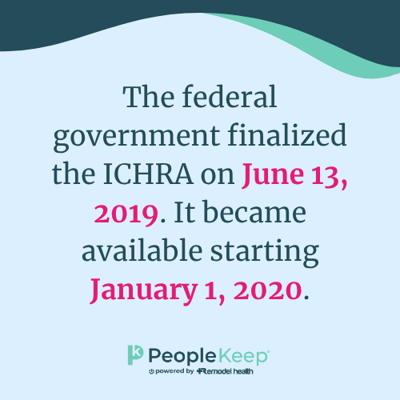
The Departments responded with proposed regulations on October 23, 2018. These were finalized on June 13, 2019, creating two new HRAs: the individual coverage HRA and the excepted benefit HRA (EBHRA).
The ICHRA was first available to employers on January 1, 2020. According to the HRA Council, ICHRA adoption has grown more than 1,000% since 2020, with more than 200,000 employees enrolled in the benefit5.
What are the benefits of an ICHRA?
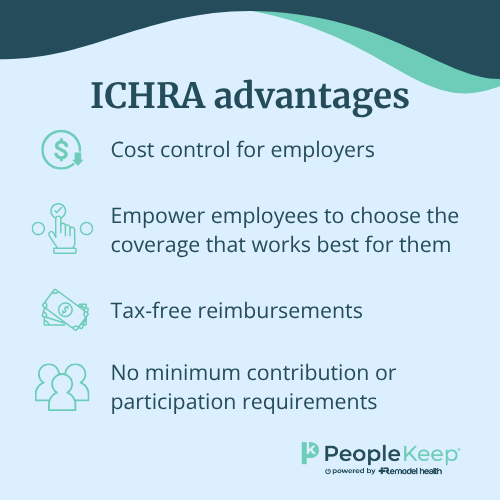
Offering an ICHRA to your employees has many benefits, including its customizable nature, no contribution or participation requirements, and tax advantages. It empowers employees to take control of their healthcare.
Empower employees to get the coverage and medical services that work best for them
With an ICHRA, instead of the employer choosing one health policy for everyone, each employee can shop for their preferred individual health insurance policy through an insurance broker or on the public and private exchanges. Now, employees can choose a plan with the network, doctors, and monthly health insurance premiums that work best for them.
If an employee already has a qualifying individual health insurance plan, they can keep their existing policy. When they leave the organization, they keep their individual policy since it’s portable and not tied to their employment.
Completely customizable plan design
You can tailor an ICHRA in several ways to meet the diverse needs of your organization and employees. By dividing your employees into classes, you can legally offer different benefits and allowances to different groups of employees based on bona fide job-based criteria. For example, you can offer different allowances to full-time and part-time employees, or choose only to offer an ICHRA to your salaried employees.
You can also vary allowances within each class based on your employees’ age and family status, such as single or married.
State tax credits for ICHRA adoption
State-level tax incentives are another potential benefit for employers considering an ICHRA. As of 2026, Indiana, Connecticut, and Mississippi offer tax credits for small employers that provide an ICHRA. These credits can help offset the cost of adopting an ICHRA and may make the transition from traditional group health insurance more attractive, especially for small business owners with strict budgets
Other states, including Ohio, Georgia, Arizona, Illinois, and New Hampshire, have introduced or explored legislation that could provide similar incentives for ICHRA adoption.
No contribution or participation requirements
Unlike other HRAs, the ICHRA has no minimum or maximum employer contribution limits, so you can offer your employees as little or as much as you choose. This allows you to customize it to fit your budget while eliminating annual rate hikes.
Remodel Health’s and PeopleKeep’s 2026 National ICHRA Report found average monthly employer contributions of:
- $591 for employee-only coverage
- $776 for employees with dependents
- $904 for married employees without dependents
- $1,036 for married employees with dependents
There are also no participation requirements for offering an ICHRA, so you don’t need a certain number of employees enrolled in the benefit to offer it. This differs from traditional group health plans, which often require 60-70% of your employees to enroll in the benefit.
Tax advantages
Under an ICHRA, reimbursements are exempt from payroll taxes for the employer and from income taxes for the employee. That means you don’t need to report ICHRA funds as income on employees’ W-2s at the end of the year.
Learn how an ICHRA compares to a qualified small employer HRA (QSEHRA).
How does an ICHRA work?
With an ICHRA, employers offer a tax-free monthly allowance to their employees for qualified individual health insurance premiums. Employers can also design the ICHRA to extend contributions to eligible healthcare costs. Employees then purchase the medical services and items they want, including individual health insurance coverage, and the organization reimburses them up to their available allowance.
If you’re new to offering an ICHRA, we can help. At PeopleKeep by Remodel Health, we’re experts in HRA administration and help thousands of employers reimburse their employees daily through our hassle-free ICHRA administration software.
Here’s a four-step breakdown of the process:
Step 1: Design your benefit to fit your needs
First, the employer designs their ICHRA benefit to suit the needs of their employees. When setting up your ICHRA, you’ll decide how much tax-free money you want to offer employees each month in a set allowance, which category of expenses you’d like to be eligible for reimbursement, and if you’d like to customize allowances and eligibility by employee class, age, or family status.
You can customize your ICHRA with the following classes of employees:
- Full-time employees
- Part-time employees
- Seasonal employees
- Salaried employees
- Hourly employees
- Temporary employees working for a staffing firm
- Employees covered under a collective bargaining agreement
- Employees in a waiting period
- Foreign employees who work abroad
- Employees in different locations, based on rating areas, states, or multi-state regions
- A combination of two or more of the above classes
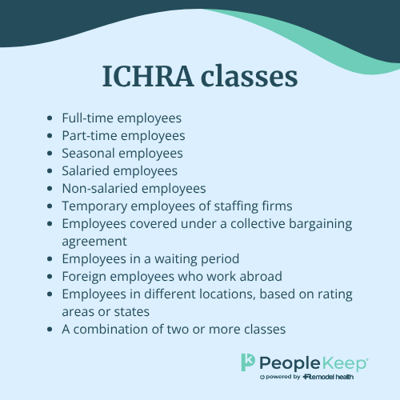
If you offer an ICHRA through PeopleKeep by Remodel Health, only full-time, part-time, seasonal, salaried, non-salaried, and state-based classes, and combinations of those, are available. If you need an ICHRA with other class categories, we can discuss your options with Remodel Health’s full-service ICHRA solutions.
In general, HRA allowances should be the same across employee classes. However, employers can make distinctions based on the employee’s age or family status.
If employers also provide group coverage and choose to structure eligibility based on full-time or part-time status, an hourly or salaried pay structure, or a geographic area smaller than the state level, the employee classes must meet a certain size requirement.
The ICHRA minimum class sizes are:
- Ten employees for employers with fewer than 100 employees
- Ten percent of the total number of employees for employers with between 100 and 200 employees
- Twenty employees for employers with more than 200 employees
Step 2: Employees make healthcare purchases
Once you set up your benefit, employees can opt into it and start making healthcare purchases. First, employees must purchase qualifying individual health insurance coverage to be eligible for the ICHRA. This includes ACA-compliant individual health insurance plans, Medicare Parts A and B together, or Medicare Part C. Then, once they opt in, employees can submit their premiums and potentially other qualified medical expenses for reimbursement.
Eligible out-of-pocket expenses may include any items listed in IRS Publication 502, although employers may limit some of these items at their discretion. For example, if you want only to reimburse employees for their premiums, you can offer a premium-only ICHRA.
Step 3: Employees submit proof of incurred expenses
Next, after employees make purchases, they’ll submit claim documentation as proof of the expenses incurred when requesting reimbursement.
The IRS requires ICHRA reimbursement documentation to include the following:
- The name of the item or service purchased
- The cost of the item or service
- The name of the vendor or service provider
- The date of purchase
Invoices, receipts, or an explanation of benefits from an insurer or healthcare provider typically satisfy this requirement. Depending on the item an employee requests reimbursement for, a doctor’s note or prescription may also be required under the regulations. Remember that this information is subject to HIPAA privacy rules, so you need to handle it carefully if you’re self-administering an ICHRA.
Step 4: Review and reimburse expenses
Finally, the employer reviews expenses and either approves or rejects the requests. If you use PeopleKeep to administer your ICHRA, our expert team will review your employees’ reimbursement requests to ensure regulatory compliance with HIPAA and other federal laws and regulations.
If the expense qualifies under the IRS guidelines, we’ll verify the request. Then, you can reimburse your employees up to their available allowance. If your employees need to submit additional documentation to prove medical necessity, we’ll notify them.
Typically, employers choose to reimburse employees through payroll by adding a non-taxable line item to employees’ paychecks. But you can also pay out ICHRA reimbursements by check, cash, or bank transfer.
Who can offer an ICHRA?
All employers with at least one W-2 employee can offer an ICHRA. This includes businesses, nonprofits, government entities, and religious organizations.
You can offer an ICHRA as a stand-alone benefit or alongside a group health insurance policy. But remember, you can’t offer the same group of employees both benefits or a choice between group health insurance and an ICHRA.
For example, you could offer group health insurance to full-time employees and an ICHRA to part-time employees, but you can’t offer full-time employees a choice between a group health plan and an ICHRA.
An organization also can’t offer a QSEHRA or an EBHRA alongside an ICHRA.
Who can participate in an ICHRA?
To participate in the ICHRA, employees must have coverage through an individual health insurance policy. Eligible policies include qualifying ACA-compliant on-exchange or off-exchange individual coverage and Medicare coverage. Employees with Medicare need Medicare Parts A and B together, or Medicare Part C.
Employees’ family members are also eligible to participate in the ICHRA provided they meet the same qualifications and the employer chooses to extend eligibility to spouses and dependents. If the employee or a participating family member ever loses individual plan coverage, they can no longer receive tax-free reimbursements or use the benefit.
Employees covered by any group plan, including a spouse’s or parent’s plan, can’t participate in an ICHRA. Other unacceptable forms of coverage include COBRA, healthcare sharing ministries, association health plans, Tricare, or being uninsured.
See the full list of eligible forms of coverage here
The ICHRA also comes with premium tax credit restrictions. Specifically, employees who participate in the ICHRA are no longer eligible for premium tax credits. For this reason, employees are free to opt out of the ICHRA and keep their tax credits as long as their allowance amount is considered “unaffordable”. However, keep in mind that ALEs must offer an affordable ICHRA allowance to at least 95% of full-time employees and their dependents to satisfy the ACA.
Beyond that, eligibility requirements are up to the employer.
Learn more about how the premium tax credit coordination works with an ICHRA
Can business owners participate in an ICHRA?
Some types of business owners can’t participate in their organization’s ICHRA. Let’s review each type of business owner below.
Can S-corporation owners participate in an ICHRA?
IRS regulations dictate that S corporation owners, their spouses, and their dependents who own more than 2% of the business can’t participate in an ICHRA. This is because owners can write off their medical expenses through other means. The IRS also doesn’t consider S corp shareholders as employees. Fortunately, this rule applies only to owners; employees can still participate.
Can C corporation owners participate in an ICHRA?
C corporations are legal entities separate from the owner. This means the IRS considers owners common-law employees of the corporation. C corp owners can participate in an ICHRA. As with all employees, this eligibility extends to the C corp owner’s family. All reimbursements paid to the C corp owner and the owner’s family are tax-free to the company and the owner.
Can sole proprietors participate in an ICHRA?
A sole proprietorship is an unincorporated business owned and run by one person. There’s no distinction between the business and the owner, so the owner isn’t an employee. This means sole proprietors can’t participate.
If the owner is married to a W-2 employee of the business, the owner could gain access through their spouse’s dependent allowance. All reimbursements would be tax-free to the sole proprietorship and the owner’s spouse.
Can partners participate in an ICHRA?
A partnership is a pass-through entity, meaning the company isn’t subject to federal income tax. Instead, the partners are directly taxed individually. Partners in a partnership are self-employed rather than company employees, so they’re not eligible to participate in an ICHRA.
Similar to sole proprietors, partners can access the benefit if they’re married to a W-2 employee of the business, as long as the partner’s spouse isn’t also a business partner.
ICHRA affordability rule
ALEs subject to the employer mandate can use an ICHRA to satisfy the employer shared responsibility provisions of the ACA. The employer mandate requires organizations with 50 or more FTEs to offer affordable health coverage that meets minimum essential coverage (MEC) and minimum value to 95% of their full-time employees.
While affordability is important to employers for compliance reasons, it also impacts employees. If you offer an unaffordable allowance, your employees can opt out of the ICHRA and choose to receive premium tax credits instead.
An ICHRA is affordable in 2026 if an employee isn’t expected to pay more than 9.96% of their household income for a self-only silver plan after using their allowance. This means your ICHRA allowance must be greater than the lowest-cost silver plan monthly premium minus 9.96% of your employee’s household income. For 2027, this decreases to 10.22% of an employee’s household income7.
How does an ICHRA compare to group health insurance?
Group health insurance is the traditional way employers offer health coverage to their employees. If you’re considering an ICHRA, you likely want to know how it compares to different types of group coverage.
A fully-insured group plan is health coverage that organizations provide to a group of employees. Employers typically cover a large portion of the monthly premiums. According to KFF, employers covered, on average, 84% of group premiums for single coverage and 74% for family coverage in 2025. This type of coverage usually requires at least 70% of employees to participate.
Fully-insured group insurance plans are expensive for many small businesses. With a small health risk pool, employees with large medical claims can drive up premiums for the entire organization. It’s not uncommon for group plans to experience double-digit rate increases at each renewal. If you’re facing a significant rate increase or spending too much on premiums, switching to an ICHRA can help you with cost control.
There are also self-insured group plans. With this type of plan, employers pay employees’ medical claims directly. This can save businesses money on premiums if their group has low utilization. However, if your employees file many medical claims or have a few very expensive ones, it can drive small businesses into financial ruin.
There are ways to mitigate the risks associated with self-funded plans, such as implementing a stop-loss policy. But an ICHRA is an excellent alternative. Employers can control their costs by setting an allowance for their employees, all without the risk of paying high medical claims. Instead, employees purchase individual health plans that cover the risk.
Here’s how the ICHRA compares to common types of group plans:
|
ICHRA |
Fully-insured group plans |
Self-insured group plans |
|
|
Plan cost |
The cost of an ICHRA depends on how much the employer wants to offer in allowances. Our 2026 ICHRA Report found that ALEs offered an average of $631 per employee per month, while non-ALEs offered an average of $1,464 per employee per month. However, employers only pay employees for medical care after they approve an eligible expense. Any unused allowances stay with the employer. There are also administrative system costs associated with using an ICHRA vendor such as PeopleKeep by Remodel Health. |
Group plan premiums vary depending on the number of employees the plan covers, plan usage, location, employee ages, and more. These plans typically have annual rate hikes that can be too expensive for small businesses. |
Health insurance costs vary based on benefit utilization and claims volume. Low utilization could result in savings over other group models. But high claims volume or expensive claims could create financial hardship. |
|
Plan funding |
Employers set a defined contribution for employees. This is the maximum amount the employer will pay per employee for the year. |
Employers pay a portion of the premium. In 2025, employers covered 84% of self-only and 74% of family coverage premiums on average. |
Employers directly pay for employees’ medical claims. |
|
Who bears the financial risk of covering employee claims? |
Individual health insurance carriers assume the risk of insuring your employees. Employers bear the risk of any reimbursement requests up to the employees’ set allowance. They don’t need to pay out anything higher than that limit for the year. |
The group health insurance carrier takes on the risk of insuring your employees. Employers are responsible for contributing to a portion of the premium costs. |
The employer assumes full responsibility for covering employees' medical claims. |
|
What employers are eligible to offer the benefit? |
Employers with at least one W-2 employee can offer an ICHRA. |
Employers of all sizes, though many plans require a minimum percentage of employees to participate. |
Any employer can offer a self-funded plan. |
|
What employees are eligible to participate? |
In general, W-2 employees can participate in an ICHRA. They’ll need to enroll in qualifying individual health insurance coverage. Employers can use employee classes to customize eligibility. |
Any employee can participate in a fully-insured group plan. Employers can use non-discriminatory factors to customize eligibility. They’ll just need to follow any regulations and carrier rules. If you’re offering a SHOP plan, you must offer the benefit to all full-time employees. |
Any employee can participate in a self-insured group plan. Employers can use non-discriminatory factors to customize eligibility. |
|
Employee choice of coverage |
Employees choose the individual plans that best fit their needs and location. |
Employees usually have only one group plan option. |
Employees don’t choose how the employer designs the plan. |
|
When do employees enroll in coverage? |
If offering an ICHRA for a January 1 start date, employees can use the individual market annual Open Enrollment Period to enroll in coverage. Otherwise, an ICHRA offer creates a 60-day special enrollment period (SEP) for employees to enroll in coverage. |
Employers define the annual open enrollment period for the plan. Employees can change coverage if they experience a qualifying life event that triggers a SEP. |
Employers define the annual open enrollment period for the plan. Employees can change coverage if they experience a qualifying life event that triggers a SEP. |
|
Contribution limits |
No. |
N/A |
No. |
|
Are there minimum participation requirements? |
No. |
Yes. |
No. |
|
Is the benefit portable? (Can employees take it with them if they leave the company?) |
No. However, employees’ individual health plans are portable. They can pay their premiums and continue their coverage. |
No. |
No. |
|
Does the benefit satisfy the ACA’s employer mandate? |
Offering an affordable ICHRA allowance can satisfy the mandate. Employees’ individual plans must meet minimum value and MEC to participate in the ICHRA. |
Yes, if the benefit is affordable and provides minimum value and MEC. |
Yes, if the benefit is affordable and provides minimum value and MEC. |
What is the CHOICE Arrangement?
The Centers for Medicare & Medicaid Services (CMS) and the Small Business Administration (SBA) announced the CHOICE Arrangement as the rebranded new name for the ICHRA at a joint event on September 3, 2026.
Congress attempted to codify ICHRA as the CHOICE Arrangement three times. Under the House-passed Lower Health Care Premiums for All Americans Act, ICHRA would have be codified in federal law as the CHOICE Arrangement, while preserving the core structure of the benefit. Employers would still provide tax-free contributions that employees can use toward individual health insurance premiums and other eligible medical expenses.
For employers, the practical difference between an ICHRA and a CHOICE Arrangement would be minimal. The proposed legislation carries forward existing ICHRA rules, while proposing some additional flexibility. Simply put, CHOICE is essentially ICHRA under a new name and with a stronger foundation in federal law.
The legislation has passed the House but is not yet law, so employers can continue to offer ICHRA under the existing rules.
How PeopleKeep by Remodel Health can help
When it comes to health coverage for your team, consider going beyond traditional group health plans. An ICHRA is a company-funded health benefit with more design flexibility than group policies offer. It gives employers a cost-effective way to offer personalized health benefits to their staff. It also empowers employees by giving them the freedom of choice in their healthcare services and coverage options.
Our new-to-benefits segment grew 71% in the first quarter of 2026 compared to the same time period in 2025, proving that the ICHRA isn't just a replacement for an expensive group plan; it’s a way for small businesses to start offering employee health benefits that make an impact. If you want to offer an ICHRA to your employees, PeopleKeep and Remodel Health can help!
At PeopleKeep, we offer HRA administration software for:
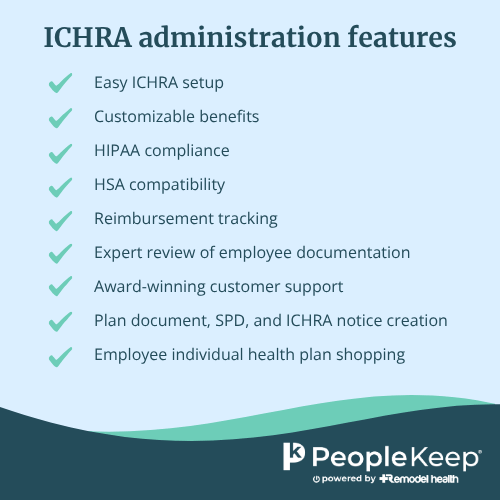
Our HRA administration software makes it easy to set up and manage your benefit in minutes each month. We can help you ensure compliance with your ICHRA by reviewing your employees’ reimbursement requests, generating required plan documents, and storing your documents.
Ready to offer an ICHRA?
Learn how Remodel Health can help you depending on your role and organization size. Select your business type below to learn more.
How an ICHRA with PeopleKeep works for small employers
ICHRA administration for organizations with fewer than 50 employees.
PeopleKeep's individual coverage health reimbursement arrangement administration software makes offering an ICHRA hassle-free for small businesses and nonprofits. Learn more about our ICHRA software or book a call with an HRA specialist.
ICHRA for midsize organizations
ICHRA administration for organizations with 50 or more employees.
ICHRA administration for organizations with 50-199 employees that don’t need full-service support.
Contact us to learn more about your options, whether with the PeopleKeep platform or with Remodel Health.
Remodel Health with ClearChoice
Full-service ICHRA administration for large and enterprise organizations.
As PeopleKeep's parent company, Remodel Health offers enhanced personalized support and expert guidance. Our deep expertise in individualized health plans helps ensure that your ICHRA needs are fully met. We combine innovative technology with the most complete service model in the industry.
Empower your clients and earn commissions
As a benefits consultant, you need every advantage to maintain your client relationships. By working with Remodel Health to offer an ICHRA to your clients, you'll get access to expert resources and earn commissions.
Frequently asked questions about ICHRA
What is an ICHRA?
An individual coverage health reimbursement arrangement (ICHRA) is an employer-sponsored health benefit that allows organizations of any size to reimburse employees tax-free for individual health insurance premiums and other eligible medical expenses. Instead of enrolling employees in a single group health plan, an ICHRA allows employees to choose their own qualifying individual health coverage.
How does an ICHRA work?
With an ICHRA, an employer sets a monthly allowance for eligible employees. Employees purchase qualifying individual health insurance and submit proof of their eligible expenses for tax-advantaged reimbursements. The employer then reimburses employees up to their available allowance. Employers can choose which employee classes are eligible and how much to contribute, subject to permitted employee classes and other plan design rules.
How much does an ICHRA cost employers?
There is no fixed cost for an ICHRA. Employers choose how much to contribute toward employees' eligible healthcare expenses, and ICHRAs don't have minimum or maximum contribution limits. This allows employers to set a budget that works for their organization.
Employers should also consider administrative costs when budgeting for an ICHRA. Total costs depend on factors such as the employer's monthly allowance, number of eligible employees, eligible expenses, and the cost of administering the benefit.
Can small businesses offer an ICHRA?
Yes. Businesses of any size can offer an ICHRA, including small businesses with fewer than 50 employees. Like other HRAs, employers must have at least one W-2 employee to offer an ICHRA.
An ICHRA can be particularly useful for small businesses that want to offer health benefits without incurring the costs and administrative burden of a traditional group health plan.
Can large employers offer an ICHRA?
Yes. There is no employer-size limit for ICHRA. Applicable large employers (ALEs) with 50 or more full-time equivalent employees can use an ICHRA to provide individual health coverage to eligible employees.
When an ICHRA meets applicable affordability and other ACA requirements, it can also help an ALE satisfy its employer mandate requirements.
What health insurance qualifies for an ICHRA?
Employees generally must have qualifying individual health insurance coverage to participate in an ICHRA. Qualifying coverage can include individual health plans purchased through the ACA Marketplace or directly from an insurance carrier, as well as certain Medicare coverage.
Group health insurance, including coverage through a spouse's or parent's employer, generally isn’t ICHRA-eligible. Other types of coverage, such as healthcare sharing ministry programs and short-term plans, may also be ineligible.
Do employees lose their health insurance if they leave a job with an ICHRA?
No. Employees generally keep their individual health insurance policy when they leave a job because the policy belongs to them, not their employer. However, they typically lose access to their employer's ICHRA allowance when their employment ends.
The employee can continue the individual health plan by paying the premiums themselves. In this way, an ICHRA provides a portable health insurance policy even though the employer's reimbursement benefit generally isn't portable.
Can employers offer different ICHRA allowances to different employees?
Yes. Employers can use permitted employee classes to offer different ICHRA eligibility requirements and allowances to different groups of employees. Classes can be based on factors such as full-time or part-time status, salaried or hourly status, geographic location, and other bona fide employment characteristics.
Employers can also vary allowances based on age and family status within an employee class, subject to applicable ICHRA rules.
Does an ICHRA have contribution or participation limits?
No. ICHRAs don't have minimum or maximum employer contribution limits or minimum participation requirements. Employers can determine how much they want to contribute based on their budget and benefit goals, and they don't need a specific percentage of employees to participate.
Are ICHRA reimbursements taxable?
Generally, no. When an ICHRA is properly designed and administered, eligible reimbursements are tax-free for employees and generally aren't subject to employer payroll taxes. ICHRA reimbursements also generally aren't reported as taxable income on employees' W-2s.
Can employees use an ICHRA with premium tax credits?
No. You can’t have both an ICHRA and premium tax credits. Employees can opt out of the ICHRA, but it depends on the ICHRA's affordability. Employees who qualify for premium tax credits must choose between participating in the ICHRA and collecting their tax credit, depending on whether the ICHRA is considered affordable.
If an ICHRA allowance is affordable, then an employee’s best option is to participate in the ICHRA. Offering an affordable allowance makes employees ineligible for premium tax credits, even if they don’t participate in the ICHRA. So, if they decide to opt out of your ICHRA, they still wouldn’t be eligible for tax credits.
If an ICHRA allowance is unaffordable, employees can opt in or out of the ICHRA based on whether the ICHRA or tax credits will give them more money. If their tax credit is larger than their ICHRA allowance, they’ll want to opt out of the ICHRA and collect the tax credit.
Can an ICHRA be used with a group health plan?
Yes, but an employer generally can't offer the same class of employees a choice between an ICHRA and a traditional group health plan. An employer could, for example, offer group health insurance to full-time employees and an ICHRA to a separate eligible class of part-time employees.
Is an ICHRA better than group health insurance?
It depends on the employer's goals and employees' needs. An ICHRA gives employers more control over their healthcare budgets and employees greater choice in their individual health coverage. Traditional group health insurance may be a better fit for employers and employees who prefer a single employer-selected plan.
Factors such as cost, workforce demographics, employee preferences, geographic distribution, and desired plan flexibility can help determine which approach makes sense.
Can an ICHRA help an employer satisfy the ACA employer mandate?
Yes. Applicable large employers can use an ICHRA to satisfy the ACA employer mandate when the benefit meets applicable requirements, including affordability and minimum essential coverage requirements. Employees must also have qualifying individual coverage to participate.
When can employees enroll in individual health insurance through an ICHRA?
If an ICHRA begins January 1, employees can enroll in qualifying individual coverage during the annual Open Enrollment Period, which is typically November 1 - January 15 in most states. The offer of an ICHRA during the calendar year and outside of Open Enrollment triggers a 60-day special enrollment period that allows eligible employees to enroll in individual coverage.
Where can my employees shop for ICHRA-eligible individual health plans?
Depending on their state, your employees can shop for a qualified individual health insurance plan directly from an insurance company, through a broker, or on public exchanges. Public marketplaces include the Federal Health Insurance Marketplace, HealthCare.gov, and state-based exchanges.
With PeopleKeep by Remodel Health, your employees can shop for health and ancillary insurance policies right from their PeopleKeep account.
What are the advantages of an ICHRA for employers?
An ICHRA gives employers greater control over their healthcare spending while allowing employees to choose individual coverage that fits their needs. Employers can customize allowances, offer different benefits to legitimate employee classes, avoid participation requirements, and provide tax-free reimbursements.
State tax incentives can provide another potential benefit. As of 2026, three states offer employer tax credits for providing an ICHRA, and additional states have considered similar legislation.
What are the advantages of an ICHRA for employees?
Employees can choose an individual health plan that fits their healthcare needs and preferences rather than being limited to a single group plan. They can compare premiums, provider networks, healthcare facilities, prescriptions, and other plan features and may keep their individual policy if they change or leave jobs.
Employees also generally receive ICHRA reimbursements tax-free when the benefit is properly designed and administered.
How does the PeopleKeep ICHRA solution differ from Remodel Health’s ICHRA?
PeopleKeep’s ICHRA administration solution is the perfect low-touch option for small businesses wanting to offer a health benefit. Many of our customers are offering benefits for the first time and appreciate our innovative technology platform and ease of use.
Businesses with 50 or more employees or those switching from a group health insurance plan might need more support and features. Remodel Health’s ICHRA platform offers a full-service concierge model with additional benefit design features. Remodel Health also boasts AutoPay for employee premiums, payroll integrations for larger groups, and in-house end-to-end service from signup through renewal.


ICHRA resources from our blog

5 steps to a successful ICHRA launch
HRA FAQs for employees
Group health insurance vs. ICHRA

Best ICHRA vendors: A look at popular ICHRA administrators

What is the CHOICE Arrangement? ICHRA's new name explained